Differences Between FFP2 Masks and KN95 Masks. Anqing Sankang Medical Technology will tell you.
Release time: 2026-01-16
FFP2 masks and KN95 masks are protective respirators certified under different national/regional standards. Their core differences lie in the certification systems, testing details, and regional applicability, though their protection levels are similar. Here is a detailed comparison:
1, Key Differences at a Glance
| Aspect | FFP2 Mask | KN95 Mask |
| Standard System | European EN 149:2001+A1:2009 standard | Chinese GB 2626-2019 (or GB 2626-2006) |
| Filtration Efficiency | ≥94% for non-oily particles (e.g., dust, microbes) | ≥95% for non-oily particles |
| Breathing Resistance | Typically stricter (balancing filtration and comfort) | Slightly less strict (but must comply with national standard) |
| Certification Body | EU notified bodies (e.g., TÜV, DEKRA) | Chinese official agencies (e.g., CMA, CNAS) |
| Applicable Regions | EU and countries recognizing CE marking | China and countries recognizing GB standards |
2, Detailed Comparison
2.1 Standards and Testing Differences
FFP2 (European Standard):
Test particles: Uses NaCl (sodium chloride) and DOP (paraffin oil) aerosols, testing both oily and non-oily particles.
Total inward leakage requirement: Includes filtration efficiency and face seal leakage, with total leakage ≤11%.
Breathing resistance: Inhalation resistance ≤70 Pa, exhalation resistance ≤30 Pa (more focus on comfort during prolonged wear).
KN95 (Chinese Standard):
Test particles: Primarily uses NaCl aerosols (non-oily particles); oily particle testing is not mandatory.
Total inward leakage: Only requires filtration efficiency ≥95%; face seal leakage is controlled by manufacturers (actual fit may affect performance).
Breathing resistance: Inhalation resistance ≤350 Pa, exhalation resistance ≤250 Pa (numerically higher, but products are often optimized).
2.2 Certification and Marking
FFP2:
Must bear the CE mark and the notified body number (e.g., CE 0194).
Labeled with the EN 149 standard and FFP2 rating.
KN95:
Labeled with the GB 2626 standard and KN95 rating.
May have LA (Labor Safety) certification or medical device registration (if intended as a medical protective mask).
2.3 Design and Wearability
FFP2:
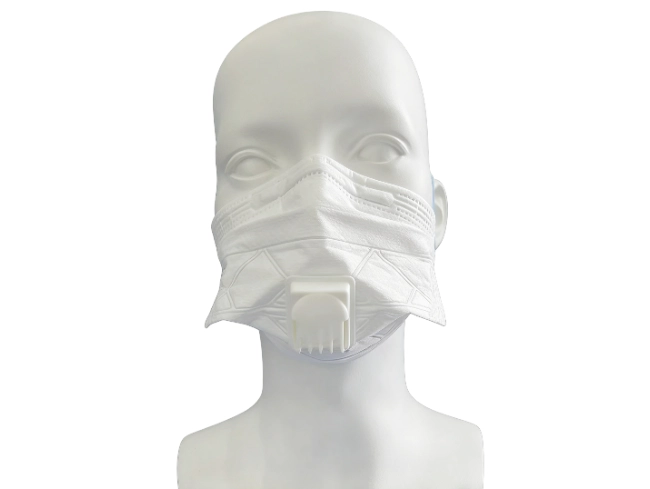
Commonly cup-shaped or foldable, often with headband design for a tighter seal.
Some models include an exhalation valve (reduces heat buildup, but unfiltered air exits through the valve).
KN95:
More design variety, often with earloops for convenience, though the seal may be slightly less secure than headbands.
Valved versions are common (valveless versions are more suitable for medical settings to prevent cross-infection).
3, Practical Selection Advice
3.1 Protection Effectiveness:
Both offer similar protection against non-oily particles (e.g., viruses, dust, pollen). Suitable for daily use against haze, flu, etc.
In medical or high-risk environments, choose valveless versions and ensure a proper fit.
3.2 Regional Compliance:
Prefer FFP2 in Europe (complies with local regulations); prefer KN95 in China.
Exported products must meet target market certifications (e.g., FFP2 requires CE for the EU; KN95 requires NIOSH N95 certification for the U.S.).
3.3 Comfort and Fit:
FFP2 headbands offer greater stability for prolonged wear but may feel tighter.
KN95 earloops are more convenient for on-and-off use but require careful adjustment of the nose clip for a proper seal.
If you are not sure how to choose the right mask, please freely contact us.